.png)
My identity as a designer of reflective interactions..
is rooted in externalising thought, and collective sense-making. I approach design challenges by immersing myself in the context and actively engaging experts, stakeholders, and users as co-creators, rather than passive recipients of value. I involve them early and continuously to build a multi-perspective understanding before decisions are made. This participatory mindset strengthens qualitative insight and leads to grounded, user-centred outcomes, positioning me within the Expertise Area of User & Society. In team settings, I often adopt an observant and democratic role, prioritising the exploration of others’ perspectives to shape a shared vision. My tendency to withhold strong opinions early on, therefore, comes from a listening character rather than hesitation. While this supports inclusive collaboration, it can also slow decision-making and delay convergence, marking an area for growth in balancing openness with decisiveness in processes. Because of this participatory approach in complex stakeholder ecosystems, I engage less with large-scale statistical validation. My strength lies instead in qualitative interpretation: translating lived perspectives into tangible design directions.


My design process is therefore both collaborative and goal-oriented. I value iteration as a learning mechanism, where even “wrong” decisions become productive moments of reflection. This allows me to navigate uncertainty while maintaining a critical focus on intended outcomes. My focus on informed decision-making is also reflected in my theory-based design approach. Although creativity is often intuition-driven, I naturally ground design choices in established frameworks, such as Self-Determination Theory (Ryan & Deci, 2000), to strengthen both the effectiveness of designs and the efficiency of the design process.
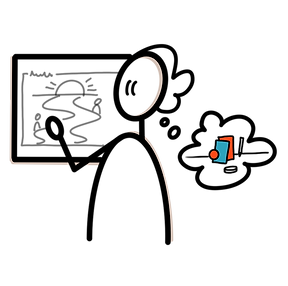
Being goal-oriented can make it challenging for me to think far outside of the box. To counterbalance this weakened openness, I rely on embodied, visual, and narrative ways of creative thinking. I externalise ideas through visual mapping and rapid physicalisation, using low-fidelity prototypes. This “thinking-through-making” makes abstract concepts tangible, surfaces assumptions, and opens up new directions that are hard to reach through discussion alone. These artefacts also act as a shared language across disciplines. Similarly, I often "design through translation" as a generative technique, reframing complex systems through metaphors to reduce them to their essence and interpret existing systems through a different lens. By doing so, I improve communication with engineers, stakeholders, and users, reducing ambiguity and aligning perspectives. This reinforces my role as a connector between user-centred insight and technical realisation, highlighting specialisation in the Creativity & Aesthetics expertise area through visual and embodied sense-making.