My development
I approach design as an exploratory process of navigating uncertainty. Throughout my bachelor’s and master’s, I moved from seeking the “right” answer toward embracing iterative experimentation as drivers of knowledge creation. Rather than treating design methods as fixed frameworks, I adapt and combine them to fit the qualities of each context. Courses such as Art & Tech (Innovation Space) and User Experience Theory and Practice further challenged me to engage with the “not-knowing” phase of design, balancing informed decision-making through methods like Design Thinking with open-ended exploration through "freeform sessions": activities detached from the project case to invite the unexpected and push beyond incremental ideas. This aligns with contemporary perspectives in design research that position creativity not as linear problem solving, but as a reflective process of experimentation and reframing.
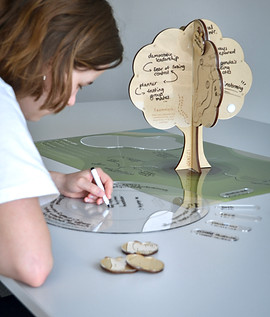
A key characteristic of my work is what I describe as designing through translation: using visualisation, metaphors, and narrative reframing to make complex systems more understandable and discussable, supporting shared perspectives that enhance collaboration among diverse stakeholders. Aesthetics function not merely as visual appeal, but as a means of engagement and reflection. For example, my M1.2 project explored how physical metaphors of vision and identity can support goal setting in design education. Across projects, from dementia healthcare (M1.1) to career education (M2.1, FMP), I adapt visual language to context. Adobe training and extracurricular courses on visual thinking (“Zakelijk Tekenen”) refined this skillset, while roles such as communication lead for student team IGNITE further strengthened this since storytelling was key in targeting diverse citizen groups.
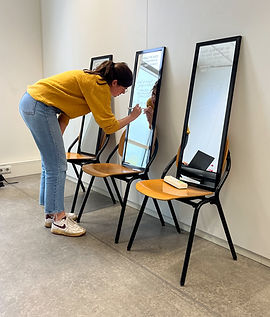
Alongside visual translation, I use prototyping as a way of thinking. Through low- and high-fidelity physical prototyping, such as through foamboard modelling, I transform abstract concepts into tangible experiences. This reflects broader developments within interaction and reflection design, where physicalisation is increasingly used to make complex systems tangible and discussable, preventing misinterpretations that often arise when ideas remain verbal. This approach has been explored across projects like Designerly Perspectives on IoT, Designing Conversational Experiences, and my FMP preparation project, where the physicalisation of interactions and conversational systems supported reflection and dialogue.

Student Team IGNITE
User Experience Theory & Practice
FMP (Prep)
Constructive Design Research
M1.1 Project
Designerly Perspective on IoT
M1.2 Research
Designing Conversational Experiences
Art & Tech

![Eureka Cover Photo [portrait].png](https://static.wixstatic.com/media/c48d3b_21ff2bf842e54e1eb494c3d636161838~mv2.png/v1/crop/x_0,y_530,w_4420,h_5189/fill/w_270,h_317,al_c,q_85,usm_0.66_1.00_0.01,enc_avif,quality_auto/Eureka%20Cover%20Photo%20%5Bportrait%5D.png)


_JPG.jpg)